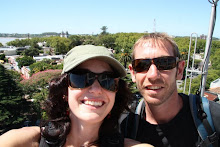
Parque Tayrona is a national park at the north point of Columbia, encompassing ocean and land. After scuba diving in one small area, we set off to spend a couple of nights in the national park which is accessed via 2 local buses and a near 2 hour hike to the campsite after paying the park fees. Dealing with intense humidity and an outraegous amount of Deet to protect from mosquitoes and midgie bites, plus the added bonus of carrying kilos of water and supplies, we were hoping this would be worthy adenture. It proceeded to surpass our expectations.
The jungle trails were home to scores of big blue crabs on the route in, and we saw a huge yellowish green snake scramble across the forest floor in front of us. Reaching the coast, palm trees towered all around and the deep bays were accompanied with massive boulders making the scene beautifully picturesque. It really was like stepping on the set off a film clip, something like Castaway with Tom Hanks maybe but with more class.
The days were spent tanning and drinking rum with our lovely Irish amiga Jules who we´ve travelled with for the last few weeks. We slept in hammocks in an open cabana perched on the top of a hill, looking straight out to the ocean and feeling the wind blow us to sleep. The seas were quite rough on the second night and it was a little cold but damp with so much humidity. Probably not the kind of bed you would want for more than a couple of nights, but a cool experience.
Trudging back to civilasation, Jeb and i needed to make our way south as our trip is nearing an end and we apparently have flights to catch. Reality check?!! But no stress yet, we hit the highway in another overnight bus (or 3 actually), and eventually made it to the sweepìng countryside and colonial town of Villa De Leyva. We stayed in a great guesthouse with backyards and fireplaces and more hammocks, and enjoyed the peacfulness. Yesterday we took bikes out for the day and explored the region including the El Fossil which is a reasonably complete fossil of a 120 million year old marine reptile called the Kronosaurus. Next we visited the Muisa Observatory (El Infiernito) which dates from the early centuries and is series of phallic looking structures (actually to be clear, they were simply big stone penises, no confusion there). There are 30 or so of them, spread out around the park about 9m apart, and were used by the indigeous people to tell the seasons. Cruising along on our bikes, we passed a cool Terracotta house, but with a huge storm beginning to drop down on us, we hightailed it back to town only to get caught in the downpour. We got soaked to the bone, but thankfully managed to dry off by the fireplace all night. A remarkable feat itself seeing the wood was soaked, but that has never stopped Jeb before. With many beers for a new friend in the hostels birthday and a late start this morning, we unfortunately didnt get to fully explore the architecture and cobbletsone quaintness that this place has to offer. 4 hours on the bus today and a broken down taxi, puts us in Bogota right now, the capital of Columbia and our last destination in this country before a flight to Chile in 4 days time.
Showing posts with label animals. Show all posts
Showing posts with label animals. Show all posts
Thursday, June 11, 2009

Monday, May 25, 2009
Cail and Salento - Columbia
So far we are loving Columbia. Guerilla warfare of recent years is no longer a common threat in most areas, and due to a huge amount of money spent by the government, the police presence is strong and combat ready and very visible. This has pushed the guerillas further into the jungle, making the country accessible to travellers. Army and police walk the streets everywhere in groups with weapons slung over their shoulders, making things seem safer rather than scary.
Added to this, Columbia is generally a really clean, hygienic, organised country with the friendliest people who will go out of their way to assist travellers and be helpful. The weather is hot, facilties are good and its not over-run with tourists. We are glad we changed out plans to come here.
We spent 2 nights in Cali, Columbia´s third largest city which is centred around a river and the Avenue Sexta which splits the city in half. Its a big city with big buildings, big banks, big roads. Cali is not necessarily beautiful, nor does it have many sites to check out, but its hot and sultry and vibrant and is the home to salsa music. So when in Rome/Columbia...i learnt to salsa. Sexta Ave is lined with large clubs and discoteques and salsateques and whilst Tuesday is the quiet night in town, we hit the busiest club where lots of young Columbian men and women were on the dancefloor. With a few Aguadientes under my belt (the main drink around here, it´s similar to Sambucca but not quite as potent and drunk as a shot with salt and lime), i was encourgaged on to the dancefloor with 2 Columbian guys from the hostel. We danced to salsa and also merengue which is a 2-step style dance and much easier. As they told me, everywhere dances here. This is what you do when you got out, and its the means for being social with the opposite sex. I cant say i was great at salsa, but it was a fun night til the music changed and loud techno music belted out and a crazy funny strip show thing for the ladies occured which is all apprently very common.
Whilst in Cali, we visited the Zoologica or simply Zoo, which was really well laid out and maintained in lovely grounds and featured lots of pumas and big cats, plus the whole gammet of zoo animals including even kangaroos. It was a really nice day til we reaslied we had been bitten by invisible midgies again and were now in for a few days of excricuating itchiness.
We hit the road again, heading for the Zona Cafetera region and a small town called Salento. We stayed in a great hostel on an old restored coffee plantatation and realxed for 3 days in the tranquil setting. The landscape in this region is beautiful and there are rolling green hills reminiscent of Scotland or somewhere, plus lovely farmhouses and green trees everywhere. We walked through the coffee plantation and were explained the processes involved, and also saw the many blackberry and banana plantations interwined between coffee plants. And of course we drank loads of delicious coffee which we have been lacking throughout our Sth American sojourn so far. As is often the way, the best local products get exported and until now, our caffiene addiction has been quenched by instant coffee or bad tea. So we rejoiced and drank it up.
Salento is a cool little town with a spacious main plaza with a few restuarants and bars and arty shops around it, and 1 main street. The style is colourful and like a Western saloon. The local characters in this story wear gum boots and somberos for working in the plantations. There are 2 billard bars, and also a venue for playing a game called Tejo. The game is played undercover and involves throwing a metal disk or puck along a kind of playing alley. You aim for a clay pit where there are pieces of gunpowder in the middle which explode when you hit it and is the ultimate score. For those who know our Sunday Games in the Park days, its similar to Bocci Golf, but with gunpowder and a similar amount of disregard for safety. With unspoken experience in this kind of game, the locals were suitably impressed at Jebs aim and ability to hit the gunpowder.
Just outside Salento, we set of for a hike through the Valley Cocora and witnessed the huge wax plam trees scattered throughout a stunning area of farming and hillsides. The wax palms are unique to this region and grow to about 70m and are now protected. The hike ventured out of open surrounds, and into a beautiful, lush rainforest trail and ended up at a house where we were served coffee by the owners and watched the hummingbirds flitter all around us. They are super fast birds and taking a picture was a challenge but you could get so close to them as they drank from the bird feeders filled with panela syrup water, which Columnians also substitute for sugar in coffee and a straight hot drink too. We rode back in the jeep which serves as a kinda of bus, but obviosuly with alot less seats and Jeb gladly snatched up seat on the roof making for a thrilling ride.
Off next to the town of Medellin, Pablo Escabor territory.
Added to this, Columbia is generally a really clean, hygienic, organised country with the friendliest people who will go out of their way to assist travellers and be helpful. The weather is hot, facilties are good and its not over-run with tourists. We are glad we changed out plans to come here.
We spent 2 nights in Cali, Columbia´s third largest city which is centred around a river and the Avenue Sexta which splits the city in half. Its a big city with big buildings, big banks, big roads. Cali is not necessarily beautiful, nor does it have many sites to check out, but its hot and sultry and vibrant and is the home to salsa music. So when in Rome/Columbia...i learnt to salsa. Sexta Ave is lined with large clubs and discoteques and salsateques and whilst Tuesday is the quiet night in town, we hit the busiest club where lots of young Columbian men and women were on the dancefloor. With a few Aguadientes under my belt (the main drink around here, it´s similar to Sambucca but not quite as potent and drunk as a shot with salt and lime), i was encourgaged on to the dancefloor with 2 Columbian guys from the hostel. We danced to salsa and also merengue which is a 2-step style dance and much easier. As they told me, everywhere dances here. This is what you do when you got out, and its the means for being social with the opposite sex. I cant say i was great at salsa, but it was a fun night til the music changed and loud techno music belted out and a crazy funny strip show thing for the ladies occured which is all apprently very common.
Whilst in Cali, we visited the Zoologica or simply Zoo, which was really well laid out and maintained in lovely grounds and featured lots of pumas and big cats, plus the whole gammet of zoo animals including even kangaroos. It was a really nice day til we reaslied we had been bitten by invisible midgies again and were now in for a few days of excricuating itchiness.
We hit the road again, heading for the Zona Cafetera region and a small town called Salento. We stayed in a great hostel on an old restored coffee plantatation and realxed for 3 days in the tranquil setting. The landscape in this region is beautiful and there are rolling green hills reminiscent of Scotland or somewhere, plus lovely farmhouses and green trees everywhere. We walked through the coffee plantation and were explained the processes involved, and also saw the many blackberry and banana plantations interwined between coffee plants. And of course we drank loads of delicious coffee which we have been lacking throughout our Sth American sojourn so far. As is often the way, the best local products get exported and until now, our caffiene addiction has been quenched by instant coffee or bad tea. So we rejoiced and drank it up.
Salento is a cool little town with a spacious main plaza with a few restuarants and bars and arty shops around it, and 1 main street. The style is colourful and like a Western saloon. The local characters in this story wear gum boots and somberos for working in the plantations. There are 2 billard bars, and also a venue for playing a game called Tejo. The game is played undercover and involves throwing a metal disk or puck along a kind of playing alley. You aim for a clay pit where there are pieces of gunpowder in the middle which explode when you hit it and is the ultimate score. For those who know our Sunday Games in the Park days, its similar to Bocci Golf, but with gunpowder and a similar amount of disregard for safety. With unspoken experience in this kind of game, the locals were suitably impressed at Jebs aim and ability to hit the gunpowder.
Just outside Salento, we set of for a hike through the Valley Cocora and witnessed the huge wax plam trees scattered throughout a stunning area of farming and hillsides. The wax palms are unique to this region and grow to about 70m and are now protected. The hike ventured out of open surrounds, and into a beautiful, lush rainforest trail and ended up at a house where we were served coffee by the owners and watched the hummingbirds flitter all around us. They are super fast birds and taking a picture was a challenge but you could get so close to them as they drank from the bird feeders filled with panela syrup water, which Columnians also substitute for sugar in coffee and a straight hot drink too. We rode back in the jeep which serves as a kinda of bus, but obviosuly with alot less seats and Jeb gladly snatched up seat on the roof making for a thrilling ride.
Off next to the town of Medellin, Pablo Escabor territory.
Sunday, April 19, 2009
Isla Del Sol - Bolivia. Puno, and Arequipa - Peru
We have been busy since the last time i wrote...changed countries, diets and currencies, hiked canyons and visited floating islands. Here´s an update...
From the coastal town of Copacabana, we took a boat for an hour and half to the tranquil island of Isla Del Sol which sits in the middle of Lake Titicaca on the Bolivian side. It was a beautiful blue sky day and we walked around this big island which has remained fairly unchanged by tourism. Villagers seve coffee in their front yards alongside their llamas, and trails are rocky leading through hills of sheeps and donkeys and plantations of quinoa which is kind of like couscous or rice and is added to soups and mashed like potato. Famous for trout, i enjoyed a change of diet from the regular Bolivian dishs of rice and chicken, and ate trout for 4 days straight. The island was really realxing so we stopped and just sat for a couple of hours on a cliff side in the sun. Being Easter Sunday, or possibly for a wedding celebration or something, there were fireworks over the lake at night before the skies turned and a tremedous storm took place overnight. We left the next day for a 3 hour bus trip across the border to Peru which was a simple process, and this is where we are now.
Arriving in Puno we could see the change in lifestyle quickly. Peru is more accustomed to tourism and people are a little more forward and friendly with travellers. Roads are more likely to be paved, toilets come equip with toilet paper (although not always), and things are just a little more organised. The food so far has been fantastic (alpaca meals have been suberb, and just new menu and market choices...woohoo), and we are throughly enjoying pisco sours which is a alcholic beverage made of pisco (white grape brandy), egg white, sugar syrup and...? Delicious.
We stayed in Puno and visted the Peruvian side of Lake Titicaca, which is the floating islands of Uros. Super touristy, but something to be seen regardless. People live and make a living on approx 80 reed islands on the lake. Its quite fascinating to get off the boat and be on a island made entirely of reeds which is soft underfoot. People fish for trout and make crafts and build reed boats as part of a very old culture and lifestyle which has been monopolised by tourism, but is still really special and intersting.
Off to Arequipa next which is where we are now. Arequipa is really quite stunning. It is the nicest city we have been in so far, however more Spanish than indigenous Sth American. Surrounded by huge snow capped volcanoes and mountain ranges, the city centre is remininscent of somwhere in Europe. The plaza is super clean with palm trees and gorgeous churches, the people and restuarants are trendy and the climate is warm.
About 6 hours from Arequipa, lies the worlds second deepest canyon called Canon Del Colca. We have just completed a 2 day/1 nights trek into this canyon (15km all up). It begins at an elevation of 3280m and plummets to the river at 2160m. So the first day is a steep drop of over 1000m, crossing the canyon and walking through local villages which are really quite remote. There are no roads here, so everything is transported by foot or mules or produced locally. We stayed overnight at the bottom in a lodging with a pool but with no electricity, and then of course...what goes down, must come up (the reverse of this saying still works here!) The trek up is said to take about 3 hours and we completed it in about 2 hours, 15 mins which is damn good going if i must say myslef, however my calves are definitely feeling it today! At the end, we visted the hot springs which, at a toasty 39 degrees, was good for the muscles. Another very cool part of this trip was a stop off at the Cruz Del Condor where condors glide through the valley and make spectacular viewing. Their wing span grows to up to 3 metres long and they come really close to the viewing point. We saw several cruise by, very impressive.
Tommorrow night, we are taking a bus to Cusco where we will spend 3 nights before beginning the Inca trail to Machu Picchu.
From the coastal town of Copacabana, we took a boat for an hour and half to the tranquil island of Isla Del Sol which sits in the middle of Lake Titicaca on the Bolivian side. It was a beautiful blue sky day and we walked around this big island which has remained fairly unchanged by tourism. Villagers seve coffee in their front yards alongside their llamas, and trails are rocky leading through hills of sheeps and donkeys and plantations of quinoa which is kind of like couscous or rice and is added to soups and mashed like potato. Famous for trout, i enjoyed a change of diet from the regular Bolivian dishs of rice and chicken, and ate trout for 4 days straight. The island was really realxing so we stopped and just sat for a couple of hours on a cliff side in the sun. Being Easter Sunday, or possibly for a wedding celebration or something, there were fireworks over the lake at night before the skies turned and a tremedous storm took place overnight. We left the next day for a 3 hour bus trip across the border to Peru which was a simple process, and this is where we are now.
Arriving in Puno we could see the change in lifestyle quickly. Peru is more accustomed to tourism and people are a little more forward and friendly with travellers. Roads are more likely to be paved, toilets come equip with toilet paper (although not always), and things are just a little more organised. The food so far has been fantastic (alpaca meals have been suberb, and just new menu and market choices...woohoo), and we are throughly enjoying pisco sours which is a alcholic beverage made of pisco (white grape brandy), egg white, sugar syrup and...? Delicious.
We stayed in Puno and visted the Peruvian side of Lake Titicaca, which is the floating islands of Uros. Super touristy, but something to be seen regardless. People live and make a living on approx 80 reed islands on the lake. Its quite fascinating to get off the boat and be on a island made entirely of reeds which is soft underfoot. People fish for trout and make crafts and build reed boats as part of a very old culture and lifestyle which has been monopolised by tourism, but is still really special and intersting.
Off to Arequipa next which is where we are now. Arequipa is really quite stunning. It is the nicest city we have been in so far, however more Spanish than indigenous Sth American. Surrounded by huge snow capped volcanoes and mountain ranges, the city centre is remininscent of somwhere in Europe. The plaza is super clean with palm trees and gorgeous churches, the people and restuarants are trendy and the climate is warm.
About 6 hours from Arequipa, lies the worlds second deepest canyon called Canon Del Colca. We have just completed a 2 day/1 nights trek into this canyon (15km all up). It begins at an elevation of 3280m and plummets to the river at 2160m. So the first day is a steep drop of over 1000m, crossing the canyon and walking through local villages which are really quite remote. There are no roads here, so everything is transported by foot or mules or produced locally. We stayed overnight at the bottom in a lodging with a pool but with no electricity, and then of course...what goes down, must come up (the reverse of this saying still works here!) The trek up is said to take about 3 hours and we completed it in about 2 hours, 15 mins which is damn good going if i must say myslef, however my calves are definitely feeling it today! At the end, we visted the hot springs which, at a toasty 39 degrees, was good for the muscles. Another very cool part of this trip was a stop off at the Cruz Del Condor where condors glide through the valley and make spectacular viewing. Their wing span grows to up to 3 metres long and they come really close to the viewing point. We saw several cruise by, very impressive.
Tommorrow night, we are taking a bus to Cusco where we will spend 3 nights before beginning the Inca trail to Machu Picchu.
Subscribe to:
Posts (Atom)