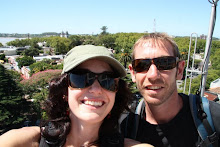
I left you last in Quito and it seems im falling behind in my writing as we have now crossed another border and are in Columbia...but more on that later. I want to give Ecuador the space it deserves, for it really was a beauiful country and we wish we could have stayed longer. Apparently you cant do everything, but i am still in denial of this.
Ecuador seems to be doing quite well economically in South American terms. The country is more developed and has better instrascture than Bolivia and Peru in particular. The roads are finished, and there is less litter and rubble on highways indicating a level of education and government expendition in such areas. Ecuadorians are proud of their ecological diversity and fertile landscapes which produce some of the juicest fruits and healty foods that we have eaten so far. In fact, we have given the title of ´Best Food´to Ecuador, with particular mention to their fantastic cheap breakfasts. We have also given the title of ´Fastest Drivers´ to the bus drivers as we have risked our lives around many speedy bends and turns in this country.
Of note in Ecuador, was the amount of Americans travelling here as a result of obvious political ties with the States. There was lots of students studying in the excellent Spanish schools, and retirees looking to buy property. Ecuador changed its national currency to the US dollar in about 2000, apparently with a lot of local resistence. Nonetheless, it went ahead and it is a likely reason for the American travellers. Another Americanism, was the streets and hostels and shop wordings in English. Not often, but certain words such as ´happy´and ´fast food´and general store...which we have not seen anywhere else.
So a quick rundown on our recent happenings....we spent 3 days in the capital Quito which is a nice city, entirely sprawling with buildings which we took in from the city´s cable car called TeleferiQo. Unfortunately, when we got to the top (4100m) , we were above the cloud line and it was a white out. So we got back inside the cable car and took in the urban junglle landscape on the way back down. We checked out a snake musuem which was filled with snakes mostly native to Ecuador, and we also walked around the entire Old Town section which narrow streets and a preseverd antiquated feel. Like most South American cities, the city sites and planning revolves around churches which are usually stunning exmaples of architecture blending Spanish and indigenous styles. The most striking church in Quito is called Voto Nacional and we climbed right ùp the top of this church to the bell towers (and rang the bells, not sure if you´re supposed to but who could resist!) and the basicilas towers which has grafitti and very little fencing and in other coutries would be major puclic liability. Very cool views and quite strange to have such free reign in a church.
The next day, we set off on public transport (they have a really efficient electric bus system called the Trole making it easy to get around Quito) to the Equator. At the hemispheric line (Mitad del Mundo) there is a huge monument marking the designated spot (which is actually incorrect by about 250km since the inception of the GPS system). We took photos and then skipped across to the Museo Solar Inti Nan which is now the actual equator line and a very intersting musuem. We jumped back and forth from the north to the south and were shown fasinating tricks on the line. For example, water has no centrigual force at the Equator and so it flushes straight down rather than in a circular motion. We balanced an egg on a nail head and got a certificate for it, and we also played around with out weight and balance as you apparently weigh 2.2% at the equator and have less resistence to gravity. On the actual line of 0¨00´00, its really difficulty to stop someone pulling your arms and hands apart. Also, walking in a straight line is incredibly difficult with no direct magnetic pull.
Next day we left Quito for the northern highlans and an area called Otavalo which is the largest markets in South America. Its starts to crank up early on Saturday morning and it was really quite overwhelming. The Otavalenos have steadfastly maintained their indigenous roots, and the traders and local folk wear their tradiotional dress all the time. It consists of long dark skirts for the ladies, with trimmings and delicate, frilly blouses, gold chains in the repitive neck fashion of African women, and often a floppy, folded hat. The men wear white baggy trousers with navy ponchos, and together they make a stylish and elegant impression. We had been waiting til now to buy things (well, sort of...we have definitely acquired things along the way!), so we shopped til we dropped and now have an extra bag of things to carry around. Well Jeb does anyway!
I mentioned we are changed our flights and are now spending nearly a month in Columbia, which is where we are now. Yesterday we spent all day on the bus, crossed borders (which again was really simple and we have had no problems at all so far), and ended up in the town of Popayan, Columbia last night. This town is beautiful. All the buildings are white and even inside the church is white. Due to many earthquakes, it has been mostly rebuilt and restored since 1983, making it very clean and tidy and breathable. There are no tight, polluted streets or high rise buildings, the climate is pleasant and the people are really modern. We have already started to see more black people which will continue as we go north and is a result of African slave labour in the caribbean area. We are moving on to the city of Cali this afternoon, so i better go eat some something....ciao
Showing posts with label people. Show all posts
Showing posts with label people. Show all posts
Monday, May 18, 2009

Monday, March 16, 2009
Bolivia
We arrived safely in Bolivia yesterday, after taking a few hours bus ride to the border. The terminal on the Argentinian side was a bit sketchy and we were prepared for the Bolivian side to be worse, but all was ok. We took a taxi from the Argentinian bus terminal and then literally walked over the border into Bolivian customs (which is not much more than a shack). No bag search, xrays, nothing. Walking through the main strip of the border town Villazon, we could instantly sense that change into a pooer, third world. There were lots of stalls on the main street selling black market and all kinds of necessities. We changed some money to Bolivianos and then got to the bus terminal. Lots of people, bit confusing with our new money and the exchange rate, and keeping our wits about us at all times, we managed to get tix for the next bus to Tupiza (about 2-3 hours from border).
The bus took off about 40 minutes late which isnt too bad for Bolivia. We were very cautious about our bags and making sure that they definitely went on that bus as we have heard some horror stories of people having things snatched from under their eyes. Bolivian buses are not great and certainly not like Argentinian buses so we were grateful for the shorter trip as our bums were already a little sore after 2 hours!
Tupiza is a very dusty town (we have surely swallowed tonnes of dust already and my thoat is perpetually dry). Its nearly 3000m above sea level so you can feel the change in altitude here. Its advised to take things slow in Bolivia so we have done that today. My favourite thing here so far is the old ladies everwhere in their traditional clothing of knee length swivel skirts, top hats, stockings, cardigans, and their hair plaited in 2 long plaits. They sit in the markets selling food and fruits (which is good here). The country has a very old culture and you can see it most in the weathered faces of the older genreations. People live in mud brick housing in villages along the roads or at the base of mountains. As in Argentina and Uruguay, the streets are quiet from after lunch for siesta and the action picks up again after 5. Even school kids break the day in two for siesta, and go back in the afternoon.
Tupiza is the final resting place of Butch Cassidy and the Sundance Kids and you can follow their footsepts around the outskirts of town. We are going horseriding tommorrow which will probably be a typical way to check out the area.
Saturday, February 28, 2009
Colonia and Montevideo, Uruguay + Tigre, Argentina
On Monday we left Buenos Aires and took the ferry to Uruguay, arriving in the town of Colonia Del Sacromento. The jouney took 3 hours although you can take a more expensive fery and get there in 1 hour. But we wanted to enjoy being on the water on a beautiful day and we are grateful for the extra time as we befriended this lovely Argentinian couple Marte and Michael. They are in their 50s, speak English and own a resturant called Captain Cook funnily enough (they offered Jeb a job!). We discussed Argentinian politics, trade and industry, culture, history etc and left ferry after 3 hours feeling so much wiser. I tried my first mate which is a national drink like tea and is everywhere in Argentina and Uruguay. The leaf is called yerba and it is kinda like a green tea but much stronger and you drink it with a metal or wooden straw. The mate cup is traditionally made out of pumpkin, but modern varities are made other materials too. People walk aound eveywhere carrying their thermos under their arm to refill their mate.
So we arrived in Colonia and explored this picturesque port town which was founded by the Portguese in 1680 to smuggle goods across the Rio de la Plata river to Buenos Aires. There are cobblestone streets and old world charm. Its beautifully restored and as a result, quite touristy but not in a bad way. Definitely worth checking out and our timing couldnt have been better as it was the annual Carnavale in Colonia on this Monday night. In South America, eveything starts kicking off really late so even for a Monday in this small town, the festivities beagn about 10.30pm. A parade rolled though the main streets with latino dancing and an afro rhythm beat supplied by a drumming procession of about 20 guys. Leading the procession were dancers of all ages, young girls, beautiful women and old grannies mostly wearing very little and showing their finest backside assets. The parade finished in a street where their was more dancing and bands and beer stalls and meat bbq stalls. Great entertainment for a Monday night, and a chance to experience some authencti street culture.
But not much else to do in Colonia so we took the bus the next day to the capital city Montevideo and spent 2 nights there. Travelling with a expat Brit Aussie guy and a Brit lady, we wandered down to the Mercado del Puetro which is basically a big market of parillas (steakhouses) where you can enjoy the hugest steaks and red wine. So we indulged again.
Whilst in Montevideo we went to the beach for a swim. The water is brown- looking due to the rocks and silt so not quite the beautiful blue waters of Sydeny but lovely soft sand and the water was warmer than Sydney has been of late so very refreshing in this summer heat. Checked out a few bars with people but Montevideo is not a huge city so 2 nights was enough and we headed back to Argentina.
Generally speaking though, i found Uruguay to be really pleasant, very green with lots of pastures and trees, and well kept building of European architecture and clean streets. The people we met were also really friendly and we enjoyed our stay.
Left Montevideo by bus to a sleepy town called Carmelo to get a different ferry back to Argentina and a city called Tigre which is about an hour north of BA. Tigre is on the Rio Del Plata and the lifestyle is centred around the river with rowing and boating. Tigre has money and is weekend getaway destination for portenos (people of Agentina), but its beautiful and leafy and relaxing. I had got the flu a little so it was a nice place to recover. Asking for flu medication in Spanish was a challenge i had to face but it was successful and im feeling much better now! Went to the mate musuem whilst we were there and had a guide who spoke no english but we got the gist of things and have now bought ouselves a mate cup and some yerba!
We went to Tigre because the Argentinian couple we met on the fery to Uruguay have their restuarnt there, so we went for lunch (was a mission and we got lost as not really somewhere western tourists go!) The restarant was on the marina and it was awesome. Marte likes Asian cooking and had told us about her Thai influenced dishes, so we enjoyed one of the best Thai green curies ever, plus an adaption of san choy boy. Was awesome food and we got a special tour of the marina and the very expensive boats moared there. Our new friends would not let us pay, so we were very lucky and left totally satisified to catch the train back to Buenos Aiers.
Which is where we are now. And its Jebs birthday today so we are going to head out tonight i think. Will keep you posted....
Subscribe to:
Posts (Atom)